Beyond the Beads: The Challenges of Pricing Native American Beadwork and other Handmade Goods
Differing Approaches, Differing Perspectives
I have found that pricing beadwork is one of the most difficult tasks. I was recently reading through the comment thread of another Indigenous beadworker’s Instagram post. She was asking for perspectives on pricing, and someone had mentioned that they purposely priced their beadwork low because they did not depend on beadwork sales to earn a living and because they had empathy for all the aunties on a budget who normally wouldn’t be able to afford some nice beadwork. I was struck by this perspective because it was something I could understand despite being someone who takes the position that beadworkers should ask for fair compensation. It sometimes feels like those of us who rely on their income through beadwork are being undercut by beaders who sell their work cheaply. I met another beadworker through Instagram who sells her work on a sliding scale based on income. She sold primarily to a low income reservation community, and I was impressed by her innovative pricing approach. I also wondered if people are generally honest about their income, and I thought it might be a good system if you are only selling directly to the customer, but more complicated if you are selling to a reseller and you haven’t established a wholesale-retail value. For many years, I worked as a buyer of Indigenous arts for Birchbark Books in Minneapolis. In 2020 I became a beadworker and now in my current role as the owner of an online retail shop that sells Native American art and jewelry, never has pricing beadwork become an easy task.

Fringe earrings by Carolyn L. Anderson
My Personal Approach to Pricing Beadwork
In my perfect world, everyone would think in terms of wholesale and retail, and all artists when selling direct to their customers would sell their work at a retail price for consistency’s sake, but that is far from the reality of things and some people expect to or even enjoy haggling, which I personally find annoying because I want to compensate artists fairly for their work. I also want to be fairly compensated for my work as the retailer, and I want my customers to be happy with the quality of the item they receive for the price they paid, so I am somewhat formulaic in my approach. For my own beadwork, for instance, I figure I should make at least $25 per hour plus the cost of materials. For many of my “standard” sized earrings, the time it takes to make them is roughly 4 hours, so I charge $100 for the time plus an extra $20 to cover materials. Currently, I give retailers a 30% discount instead of the usual 50% because beadwork is time intensive. I don’t want the retail price to be set so high that most people wouldn’t buy them, but I also want to pay myself fairly, so this has been my solution, for now. When I sell those same $120 earrings retail at a 30% discount, I am making roughly $21 per hour.

Cream Cascade Fringe Earrings by Moongrove Beads (Tasha Tetpon)
Differing Values
I find it ironic that there are many people out there who would not think twice about buying very expensive designer label apparel, but who might wonder why Native American beadwork is so expensive. In the article, “Why Indigenous Beadwork is My Idea of Luxury” Christian Allaire, an Ojibwe writer for Vogue, writes about his own experience with this attitude. He describes growing up on the remote Nipissing First Nation in northern Ontario where he “attended powwows and watched dancers in their full regalia wearing pieces, which took weeks to months to produce.” He remembers realizing that “luxury items to Natives are pieces which are valued for their spirit and not their monetary value.” Even so, when he was younger, he was enthralled with designer labels, maybe because it was something that he didn’t have access to while living on a remote reserve. Years later, when he was able to buy his first pair of Prada sneakers, he was hit with an unshakeable feeling of buyer’s remorse. Christian says, since that day he “still feel uncomfortable [...] buying anything unnecessarily extravagant,” and would much rather splurge on beadwork than designer labels. He acknowledges beadwork “is a particularly time-consuming art form. Indigenous artists bead each earring, bag, or necklace by hand, a laborious process that demands loads of patience and skill.” [1]
Another Indigenous Retailer’s Perspective
In a CBC article written by Sara Kae, an Ojibway/Cree reporter based in Thunder Bay, Ontario, I discovered another business, called Aaniin Retail Inc., which is similar to mine in that it is a retailer that sells other Indigenous businesses’ products. The business was founded by Chelsea Pettit of Aamjiwnaang First Nation. “She said it can be a struggle to set appropriate prices for not only her work, but that of others as well. She found a price analysis of vendor's products to be crucial because […] many artists undercut themselves. Pettit said she takes the liberty of increasing the prices to not only cover overhead such as customer service but to ensure the artists are being properly compensated. ‘The more Indigenous creators price their work where it is valued, the more the industry for Indigenous artisans will be elevated.’” [2]
The Impact of Fast Fashion
In the same article, Sara Kae introduces us to Diane Simon of Fort Folly First Nation in New Brunswick who works as a midwife in Toronto. Growing up, she watched family and friends dedicate hours to beading, sewing, and basket making so she understands the effort that goes into their creations. Simon said customers forget that handcrafted items are investment pieces that are one of a kind, different from the "fast fashion" world we live in, she said. "We want to be able to share and sell items we make so we need to find that balance, in terms of a comfortable price," she said. "The people you are buying from, it's them directly […] So if you're not compensating them properly that's having a direct impact on their family dinner that week." [2]
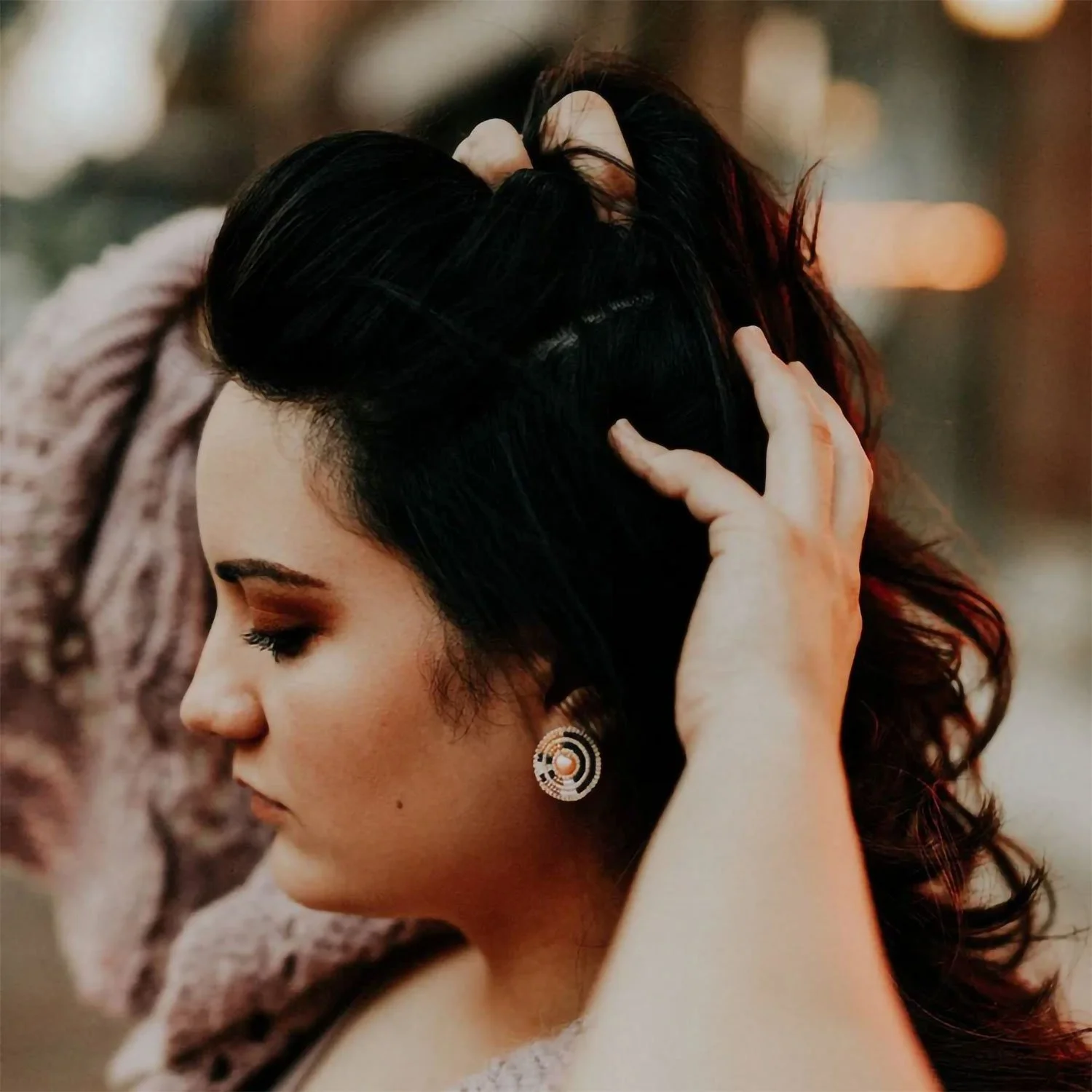
Circle Direction Earrings by Cheyanne Symone
I think Diane brings up an important point. We do live in a world where fast fashion is the norm. Many of us have closets filled with clothes we rarely if ever wear. We occasionally sort out the least worn clothes to make room for new outfits we may not wear either. Each of these pieces of clothing are sewn in an industrial factory setting, but they are sewn with human hands and the people who make them more than likely are living on very meager incomes. I am by no means shaming anyone for contributing to this system. I am guilty as well. Our economy, to put it plainly, is in the shitter, and affording anything of decent quality, let alone food, is a constant struggle for many of us. I understand the pursuit of a good price, but I also understand we must strive to do better. There are a multitude of ways we can do this. Shopping in thrift stores, learning how to tailor and mend your clothes, trying to remove the idea from your mind that you need a ridiculous number of outfits, purchasing a few quality pieces you know you will wear again and again and that will hold up over time, purchasing clothes or accessories from artisans or from companies who are local, and of course never feel guilty about buying beautiful, heirloom quality, beadwork. It is medicine for your heart and soul.
Written by Carolyn L. Anderson
Carolyn is a member of the Navajo Nation, an artist, and the owner of Old Cedar Native Arts
If you found this article interesting or if you’d like to share your own perspective on pricing Native American beadwork or other handmade goods, I welcome your comments below!
Sources:
1. Allaire, Christian. "Why Indigenous Beadwork Is My Idea of Luxury." Vogue, Condé Nast, February 27, 2020. https://www.vogue.com/vogueworld/article/why-indigenous-beadwork-is-my-idea-of-luxury (accessed March 6, 2025).
2. Kae, Sara. “Indigenous artisans struggle to navigate product pricing.” CBC/Radio Canada, August 24, 2023. https://www.cbc.ca/news/indigenous/indigenous-artisan-product-pricing-1.6946247 (accessed March 6, 2025).